

When going on a trip, we usually want to relax first and foremost. Well, and if possible, see something new and compare it with our usual life.
A recent trip to the Adriatic coast, to Montenegro, in addition to a great vacation, provided an opportunity to look at our everyday life in Ukraine as if from the outside. Just a one-and-a-half-hour flight from Odessa to the small airport of Tivat, and you’re already enjoying stunning views on approach.
The sea here is special, and you notice it from the plane. It’s the special clarity of the water, its azure color, and the smooth transition from green to blue, something indescribable, promising some kind of miracles. Which you will feel and appreciate directly in the water. The seawater here, unlike our Odessa version of the Black Sea, diluted by the Danube and Dniester, has a much higher salinity, with a sharp salty-bitter taste. You can lie on it, with your arms and legs spread out. And if you dive with your eyes open, you experience quite a strong burning sensation, forcing you to rub them for a long time. Perhaps this is somehow related to the clarity of the water, as visibility even at great depths is absolutely stunning. Wikipedia reports that the transparency of seawater reaches 35 meters in places. I won’t dispute or confirm the measurement, but I can confirm that when swimming with a mask at depth, you experience dizziness from the sensation of free flight at height. Moreover, you can enjoy the views of the seabed not only with equipment. Many pleasure boats are equipped with a glass bottom, through which you can observe the seabed.
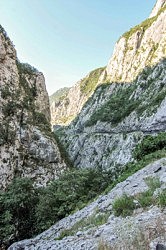
The second universally recognized, as they say, “feature” of Montenegro is, of course, the mountains. Although those who have been to the Carpathians will probably not see anything too special. The only thing, and quite objectively, that the Montenegrin mountains “outperform” the Carpathians is the depth of their river canyons. The canyon of one of Montenegro’s mountain rivers, the Tara, is about 1200 m deep and is the deepest in Europe and the second deepest in the world.
In general, if by some magic the sea were moved to the Carpathians, or vice versa, the Carpathians were moved to the sea, then, in my opinion, you wouldn’t notice the difference with Montenegro. But this is all hypothetical! In reality, the impressions from walks around the resort town of Petrovac, our former place of residence in Montenegro, where the sea air mixes with the aromas of the coniferous forest, which rises like a wall into the mountains, were simply magnificent!
And if you consider that all of Montenegro is covered by a network of excellent roads, the quality of which we can still only dream of and which are actively being built in all directions, then the set of objective circumstances for a wonderful vacation is evident.
However, a vacation is still a subjective thing for everyone, and therefore even the greatest set of beauties and excellent conditions does not guarantee that you will truly relax completely. And the first thing that constantly subconsciously tensed me was that Montenegro, while still only a candidate for the European Union, had already introduced the euro as its currency.
At the time of my trip to Montenegro, the euro cost 30 hryvnias, and therefore, no matter how hard I tried not to multiply each price tag by 30, nevertheless, buying a liter of the cheapest still mineral water for 80 cents or a half-liter mug of local beer “Nikšićko” for two euros was somehow unpleasantly stressful. I didn’t try to find out what the local residents’ salaries were. But from indirect signs, as well as from the stories of the girls from the travel agency that handled us, and the owner of the villa where we stayed, I understood that things were not so rosy here. It’s understandable that in the coastal towns, the focus is solely on serving tourists. But it turned out that in general, throughout Montenegro, there is a bias in this direction.
According to official sources, the state’s policy is aimed at the comprehensive development of the tourism sector, and it is given priority over industry and agriculture. This is evidenced, in particular, by Montenegro’s proclamation as an “ecological state,” which essentially put an end to industrial development. 76.8% of the working population is employed in the service sector. As a result, after the main tourist season, which lasts from May to October, the “dead season” begins, during which all the earnings from the summer can be “eaten up.”
In particular, local residents were very frightened by the past winter, during which the temperature, which usually did not drop below +7 degrees, suddenly dropped to -14 for the first time in 100 years! The houses in the coastal zone, built for warm winters, turned out to be unprepared for such temperatures, as they only had electric heating. As a result, the electricity bills were catastrophic. As the girls from the travel agency, one of whom was our compatriot and the other from Belarus, told us, there is nothing to do here in winter, it is expensive to live, and there is no work. They always leave Montenegro for the winter. And the owner of the villa where we stayed said that in Petrovac, dogs don’t bark in winter. Simply no one to bark at.
True, it is during this “dead season” that the main construction work takes place in the coastal zone, as all construction is prohibited during the resort season so as not to disturb tourists. However, the question arises: who exactly works on these construction sites? The fact is that, judging by the stories of those we spoke with, the main labor force in Montenegro consists of migrants. First of all, Bosnians and Serbs were mentioned, and in the sphere of providing tourist services, as we could see for ourselves, Eastern Europe “rules.” Montenegrins themselves, if the impressions are correct, perform managerial and representative functions, or very specific ones. For example, the same girls from the travel agency assured us that the most respected male professions in Montenegro are… waiters and tourist bus drivers. But what do they do in the off-season?
So, despite all the beauty and well-maintained appearance, Montenegro still does not seem like a country whose example should be followed in everything. Tourism is undoubtedly a good thing, but it is seasonal and highly dependent on the external situation. Any escalation of international relations, any conflict nearby can scare away vacationers. And what then will 70% of the population “geared” to serve them do?
In this regard, a very difficult situation is developing with the main contingent of vacationers, who, judging by Petrovac, are Russians. On April 20, Maria Zakharova, the official representative of the Russian Ministry of Foreign Affairs, stated that “anti-Russian hysteria” had begun in Montenegro and urged Russians to “take these circumstances into account.” This was due to Montenegro’s steps towards rapprochement with NATO, and on June 5, 2017, the official ceremony of Montenegro’s accession to the alliance took place at the U.S. Department of State in Washington.
Nevertheless, if there was a decrease in the number of vacationers from Russia, it was not externally noticeable. This was particularly evident at Tivat airport, where Russian planes landed and took off almost every half hour. Nevertheless, this flow can be simply cut off at any moment, and then the fate of Petrovac, considered a family vacation spot for Russians, will be very problematic.
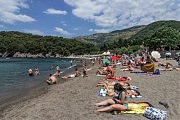
Nevertheless, by the end of July, the flow of tourists was as abundant as ever. And for those who love a more or less secluded vacation, the problem was that finding such a place on the Montenegrin coast was very difficult. The coast is mainly composed of steep and sheer cliffs, with large and small bays and coves here and there, which can be reached either by land or by sea. It is in these places that the resort towns are located and the masses of vacationers are concentrated. Therefore, the concentration of vacationers in the towns and on the beaches is quite high.
Of course, the magnificent sea compensates for the need to constantly share it with someone, but the constant presence of large crowds of people in a limited space was still stressful. And even in places that can only be reached by sea, the well-organized boat traffic ensured a considerable number of vacationers. In this regard, our Odessa coast, though not with such a sea and infrastructure, but allowing, if desired, to find solitude, was remembered with a slight sadness.
Overall, the return home, despite marking the end of the vacation, was very pleasant. It may sound strange, but I was very pleased with the prices, which, after the Montenegrin ones, were more than acceptable. The strength of the walls of our houses, the variety of heating methods, and the readiness for any weather vicissitudes instilled confidence. It was pleasant to realize that, whatever the case may be, Ukraine as a whole is a self-sufficient country, not dependent on the whims of tourist flows. And the fact that for the majority of our population there is still no “dead season” that makes them look into the future with fear. So don’t think and say that everything is bad here. Travel and see for yourself!











