

In the town of Tarutino, Odesa region, a monument to the victims of the Holocaust was solemnly opened
Before the Second World War, the Tarutino district was widely known in Eastern Europe for its rich harvests of grain and vineyards, a traditional fair that gathered up to 10,000 buyers and sellers every two weeks, the skill of numerous artisans, as well as the education of graduates from German and Jewish gymnasiums, who then entered the famous universities of Sorbonne and Cambridge. The abundance and prosperity of this region were largely achieved through the hard work and knowledge of the German colony and the Jewish diaspora, which constituted the majority of the population in the area.
But after Bessarabia was annexed to the Soviet Union in 1940, in accordance with the Molotov-Ribbentrop Pact, the former well-being ended. In accordance with the agreement between Hitler’s Germany and the Stalinist authorities, all Germans were transported to their historical homeland. Then came the period of collectivization. And when in July 1941 the fascists, along with Romanian troops, entered Tarutino, it was the turn of the Jews.
On the appointed day, all Jews of Tarutino were ordered to report to the assembly point. None of them could have even imagined the subsequent actions of the punishers. All the Jews – men and women, old and young – were lined up in a column and led to the northern part of the settlement. There, at the bottom of one of the ravines, 352 civilians were shot. Only one 12-year-old boy, Misha Bresh, managed to escape, to whom his grandfather had managed to say: “At the first shots, fall to the ground, and I will cover you with my body.”
After the war ended, the population of Tarutino changed, and there were almost no old-timers left who remembered the Tarutino “Babyn Yar.” Almost no one knew about the brutal crime of the fascists and the tragedy of the Jewish diaspora in this region.
THE FIRST PERSON TO DECIDE to restore the memory of the murdered Jews in Tarutino was Alexander Doiban, who shortly before the war, at the age of 12, moved with his parents to Odesa. After the war, he came to his native region to visit relatives and friends… But, as it turned out, they were all shot. Then Alexander Moiseevich vowed to do everything possible to make this tragic page in the life of Tarutino known to everyone, so that the memory of the innocent victims would live on for centuries.
Life made its own adjustments to these noble intentions. Doiban graduated from the Odesa Institute of Marine Engineers, was assigned to work at the Murmansk Shipping Company, where over the years he became deputy head. For his valiant work, he was awarded many government awards and has the title of “Honorary Polar Explorer.” Now the veteran is 86 years old, and he lives with relatives in New York.
All these years, with each visit to Tarutino, he moved step by step closer to achieving his goal. During one of his visits, Alexander Moiseevich met amateur local historian Vladimir Kubyakin, who had done a tremendous amount of work studying the history of his district. He wrote a book and knew about the tragedy of the Jewish diaspora from his grandmother, whose sister miraculously escaped execution.
“I found the first documentary evidence of the Tarutino Holocaust 6 years ago in the Izmail archive,” says Vladimir Viktorovich. “It was a report from a party commission on fascist atrocities in the region. Then followed research in the archives of Odesa, Kyiv, St. Petersburg, and Moscow. I managed to find out the exact number of victims and the 142 names of those who stood at the bottom of the ravine before the execution that day. In the Kharkiv Holocaust Museum, I also found the memoirs of Misha Bresh, the only survivor of that massacre. Work in this direction continues, and it will not end until we know the names of all the murdered Jews. Unfortunately, I can’t imagine how to find the exact place of death of my fellow countrymen yet. The punishers leveled that ravine, and years and nature completely destroyed the traces of mass death.”
Alexander Moiseevich’s desire and financial capabilities, multiplied by Vladimir Viktorovich’s research activities, created the historical and material basis for the project’s implementation. Its coordinator was Roman Morgenstern, development director of SK “Ukrferry,” whose father, Solomon Ruvinovich, worked for many years as a senior mentor mechanic at the Murmansk Shipping Company, was friends with Doiban, and knew about the Holocaust in Tarutino from him. Roman visited Tarutino several times and, together with Vladimir Kubyakin and local authorities, resolved all organizational issues regarding the installation of the monument.
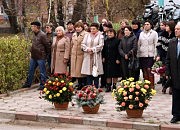
AND THEN THE SOLEMN DAY ARRIVED. On Mira Avenue, near the house where the Jewish gymnasium was located, residents of Tarutino, district leaders, and the Odesa Regional Association of Jews – former ghetto and concentration camp prisoners gathered.
The rally was opened by the mayor of Tarutino, Ivan Kuruch, deputy chairman of the district council, Vasily Ivanov, historian and local historian, author of the book “Budjak,” Vladimir Tkachenko. In their speeches, they noted the role of the Jewish diaspora in the creation and development of Tarutino in the pre-war years and emphasized the significance of the monument to the victims of the Holocaust as a symbol of eternal memory of the murdered Tarutino Jews.
Then, the chairman of the Odesa Regional Association of Jews – former ghetto and concentration camp prisoners, Roman Shvartsman, a member of this association, Mikhail Zaslavsky, and a “Righteous Among the Nations,” Vasily Voloshin, who saved 17 Jews from certain death at the risk of his own life during the fascist occupation, spoke. They spoke about the tragedy of the Jewish people during World War II and shared memories of the fates of Odesa Jews during the city’s occupation.
Roman Morgenstern spoke about the life and work of the initiator and sponsor of the monument’s creation, Alexander Doiban. He emphasized the importance of friendship and cooperation among people in this multinational region in those distant years, where, in addition to Germans and Jews, Ukrainians and Bulgarians, Russians and Moldovans, Armenians, Serbs, Gagauz, and representatives of other nationalities worked side by side.
A solemn moment. The white shroud is removed from the monument. The words in Russian and Hebrew are inscribed on the black marble, telling about the Tarutino Holocaust. And the most important thought for our contemporaries and future generations: “Eternal memory to the innocent victims!” A moment of silence, flowers at the pedestal.
Our visit to Tarutino ended at the former German gymnasium, built at the beginning of the last century, but retaining its solidity and quality. Here, in several rooms, are exhibits of the German Cultural Society “Bessarabian House.” Most of them are provided by descendants of Bessarabian Germans living in Germany today, who hold a general gathering in Stuttgart every two years. They honor the memory and deeds of their ancestors, periodically visit the Tarutino district to revive the former well-being and prosperity in this blessed region. According to Svetlana Kruk, chairman of the German Cultural Society, descendants of German colonists are ready to invest millions of euros in agriculture and winemaking in this region. And what is stopping them?
We did not expect an answer to this question. It was already clear after the road from Odesa to Tarutino. Dozens of kilometers of potholes and ruts on this road make the entire Bessarabian region currently completely unpromising for development and investment.











