

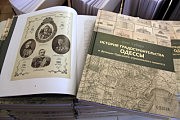
“He is a true chronicler of Odesa,” said Galina Bezikovich, creator of the international book exhibition-fair “Zelenaya Volna,” referring to local historian Oleg Gubary, congratulating him on the release of his new book at a presentation in the Golden Hall of the Literary Museum on September 10. The voluminous illustrated edition “History of Urban Development of Odesa and the Functions of the Odesa Construction Committee” is the result of more than ten years of meticulous research by Oleg Gubary, Honorary Citizen of Odesa and laureate of the “Evening Odesa” contest “People of Action”…
“Gubary never makes mistakes. He is a true chronicler of Odesa,” said Anatoly Gorbatyuk, a member of the presidential council of the World Club of Odesans, at the presentation.
“More than ten years ago, I learned about the author’s intention for this book,” says Alexander Tretyak, Candidate of Historical Sciences and reviewer of the publication. “After all, in the eighties, even mentioning ‘old Odesa’ caused rejection in the officialdom. It’s hard to believe now, but the Museum of History and Local Lore did not have portraits of de Ribas, Richelieu, or Vorontsov. The release of Oleg Gubary’s book is a much deeper event than it seems at first glance. Until now, we had scattered monographs, fragmentary results of many studies. But Gubary’s book is a fundamental generalization of a huge layer of information.”
“Whatever theme we take for museum development, we cannot do without Oleg Gubary’s books,” stated Elena Karakina, scientific secretary of the Literary Museum and Honored Worker of Culture of Ukraine. “How many times he used to sit in the archive – dressed in a ushanka, a padded jacket, and felt boots, in the bitter cold, leafing through documents with freezing fingers! It was Oleg Gubary who established that Robert Stevenson stayed at the ‘London Hotel’ during his visit to Odesa on his last round-the-world trip. Or, for example, we knew that Jan Potocki, the author of ‘The Manuscript Found in Zaragoza,’ had been to Odesa – but where exactly and what did he do here? Oleg Gubary found that out. And the fact that pirates operated in Odesa Bay – if there are merchants, why wouldn’t there be pirates? – Gubary documented this…”
As a museum employee, I have repeatedly encountered both ignorance and opportunism. But Gubary is an archaeologist: he knows that history must be excavated!”
“He writes two different kinds of prose. One is reckless adventurism, playful mischief. The other is strict factual evidence, the conclusiveness of historical arguments.”
…Vladimir Levchuk, Director of the Odesa Regional State Archive, noting Oleg Gubary’s highest conscientiousness as an archive regular, drew the public’s attention to the archive’s problems, calling for cooperation. Soon, the archive user will no longer need equipment like a padded jacket and felt boots: renovations of the archive premises are underway, and heating has been installed. But… there is not enough space for document storage!
Oleg Borushko, organizer of the literary festival “Pushkin in Odesa,” spoke about Pushkiniana: “Gubary once said that the ‘Pushkin places’ in Odesa are a complete apocrypha, and his goal is to recreate the authentic Pushkin routes. The first result: the unveiling of a memorial plaque on the building of the former Richelieu Lyceum (Deribasovskaya Street, 16). Pushkin visited this building and was very popular among the lyceum students.”
“We talk a lot, but we know little,” said the guest of honor to the audience. “This book of mine is not about architecture, although it is about architecture ‘among other things’; it is about how the city was built, how its districts were formed, how the science of engineering and geological surveys developed in it, and how city gardens and parks were laid out. It is the history of urban planners. And the book arose from the mass of accumulated information from which several books have emerged: about the history of the Jewish community of Odesa; about Odesa cemeteries; and now about the Odesa Construction Committee.
The main theme for me is people. The book was partly made out of a sense of bitterness and resentment: for people, for history. Books are written out of love, pity, and compassion, not out of ambition. We are wounded by our city. Books about the history of Odesa are our resistance to its current wretchedness, to attempts to trample and push our city down.”
At the end of the presentation, copies of the book “History of Urban Development of Odesa and the Functions of the Odesa Construction Committee” were presented to representatives of libraries, museums, and public organizations of the city, as well as to the regional archive.











