

This day in Odessa passed without incident
Odessites had never seen Kulikovo Field like this before. Fenced off along its entire perimeter, with police guards every few meters, with a long line of powerful trucks full of fighters along the adjacent street. On the approaches to Kulikovo, military personnel in camouflage were encountered frequently. Some were armed.
In a city divided by tragedy into “us” and “them,” the authorities did everything they could to show they didn’t want a repeat. In any case, the opposing sides had previously agreed that there would be no marches. Mobile communication was blocked in the center of Odessa. And near the places where people died – on Kulikovo Field and Sobornaya Square – memorial services were decided to be held simultaneously, on two days.
More than a thousand law enforcement officers were concentrated on the main city square, Kulikovo Field. They were everywhere, even on the roof of the House of Trade Unions that had burned down during the tragedy.
At the entrance to the square, a woman with a determined look was displaying a poster that read “The World Knows the Truth.” Opposite the meaningful text was a table with the inscription “Headquarters.” Between them were five white tents. Under the tents were metal detectors. A police officer politely offered me to put everything that might ring into my briefcase and pass under the metal arch. I started to reach for my documents – it wasn’t necessary.
People with flowers walked along the alley towards the center of the square. Many were under thirty.
“What brought you here?” I asked a girl standing a little apart from the crowd, which numbered perhaps over a thousand people.
“To honor the memory of the people,” her somber face remained focused.
“What’s your name?”
“Natasha,” she replied reluctantly. She clearly didn’t want to talk. Unlike the speakers, who passed the megaphone from one to another. From time to time, shouts of “Fascism will not pass!” and “Odessa is a hero city!” rippled through the crowd.
Black balloons rose into the sky, white doves soared. A grandmother in a neatly tied headscarf was handing out cookies specially prepared for this day.
People brought flowers, many flowers, to the yellow and blue fence that had cordoned off the House of Trade Unions. Part of the fence was covered in black. Here were the names of those who perished.
I peered into the faces, trying to understand their mood. Sadness, heartache, and sometimes hatred could be read in their eyes.
“I received the Twentieth Anniversary of Victory medal in this building,” an elderly man said heatedly. “And now – what?”
And without mincing words, he escalated his hysteria to rage.
Not everyone liked the presence of “1+1” on the square. They said, “What is Kolomoisky’s channel doing here?” However, the police quickly suppressed an attempt to prevent filming.
Up to a thousand people came to the place not far from which the first victims were fatally wounded last year. Here, on Sobornaya Square, under the shade of Ukrainian flags, a memorial service was held for all those who died that day. And everyone in the square knelt. There were many heartfelt words. With a bitterness that had not faded over the year.
And people kept coming to the place of the first fatality. Here, a handsome, sturdy man of about thirty-five laid flowers and crossed himself. We started talking.
“I came to pay respects to those thanks to whom it is peaceful in Odessa,” sighed entrepreneur Igor Koval. “If it weren’t for these guys, and those like them, we would have a second Donbas.”
As is known, on the eve of May 2, law enforcement officers “cleansed” Odessa, detaining twenty people. And a little earlier, they had apprehended about a hundred. Including those on whose conscience were the explosions that agitated the city. Weapons, maps, and other documents were found – evidence that “fun” was being prepared for the city in May.
At a briefing at the end of April, the head of the regional state administration, Igor Palitsa, stated that on May 2, order in Odessa would be guarded by two and a half thousand police officers and one and a half thousand members of public formations from all over the country.
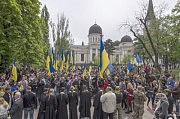
“Experienced specialists from the central office of the Security Service of Ukraine have arrived in Odessa, including those participating in the anti-terrorist operation in the east of the country,” the SBU warned. And indeed, it was visible on the streets: BTRs and other armored vehicles had been deployed to the city.
The square was cordoned off the evening before. Explosives technicians were working there: they were checking the area where the memorial service was to be held. And for security reasons, the cordon was maintained on May 2.
A message from the Prosecutor General’s Office also served as a peculiar warning: suspicion had been brought against police colonel Petr Lutsky. He headed the regional police department a year ago and became a defendant in a criminal case initiated due to his official negligence.
“He failed to ensure proper public order protection,” the department’s press service reported. “This led to a clash between a column of people marching ‘For Unity’ and an organized group of individuals who attempted to prevent the event in the vicinity of Grecheskaya Street.
Mass riots began, and the situation got out of the control of the internal affairs bodies.
As a result, 18 people received gunshot wounds in the vicinity of Grecheskaya Square, six of whom died. During the fire in the House of Trade Unions on Kulikovo Field, 42 people died, of whom 10 suffered bodily injuries from falling while trying to escape the fire, and 32 died from carbon monoxide poisoning and combustion products.”











