

Composer Alena Tomlenova (Odessa — Moscow) has received the opportunity to present a long-dreamed-of and nurtured work to the public: “The Odessa Legend” based on the stories of Isaac Babel. The premiere took place on April 9th in the Grand Hall of the Philharmonic.
An opus at the intersection of genres and forms, like many contemporary works; the author herself gave it the subtitle “Ironic Scenes with Singing and Dancing.” There were no dances this time — the scenes were presented in an ascetic concert version. Vocal solo parts were performed by students of the Odessa National Music Academy named after A.V. Nezhdanova; the chamber orchestra of the Odessa Philharmonic was conducted by Honored Artist of Ukraine Vadim Perevoznikov. The full title of the work is “The Odessa Legend: The King and the Father,” written in 1995, but over the past ten years, the author has repeatedly returned to the piece, refining and polishing the details.
…As soon as the melancholic klezmer music of the prologue “Morning on Moldavanka” began — I wouldn’t say it “flowed,” because it was not provincial but rather strictly and nervously jazzy — I couldn’t help but smile: this is still that Tomlenova, faithful to her great source, following the musical path of a great Pioneer. He is her guiding star: Dmitry Shostakovich. In the mid-90s, this was very noticeable. The question is, does she follow him “obediently”? My answer: hardly. It’s hardly appropriate to talk about “obedience” here, which implies faithful imitation. This is simply a case of “like-mindedness” in musical worldviews.
In art, nothing arises from nothing. One must, as clearly as possible, define the musical “pedigree” of our composer, a fifth-generation Odessan. I will resort to a quote. This necessity seems fundamental to me. Literary critic and film scholar Lev Anninsky once expressed himself with a precision that few music critics are capable of. So, in 1932, the 25-year-old Dmitry Shostakovich completed his opera “Lady Macbeth of the Mtsensk District” (“Katerina Izmailova”)…
“Shostakovich’s opera is recognized as a milestone in the development of 20th-century music. Many of the ideas established in it have become the basis for the modern concept of operatic art… it presents continuous symphonic development of the musical whole. It is intoned capriciously, sharply, and ‘illogically,’ with instantaneous shifts and immediate emotional reactions to these shifts… The orchestra, from an illustrator of events, becomes the predominant element: the orchestra is the ‘author’s voice,’ the narrator, and the judge… Tragedy is combined with satire, grotesque with everyday characterization, and pathos with irony according to a completely new logic. This is not music of sublime experience, but music of impulse, music of gesture, music of nervous shortness of breath and bold defiance.
…Among the main arguments of the article “Chaos Instead of Music” was that Shostakovich “borrowed his ‘nervous, convulsive, epileptic music’ from jazz.”
A strike of the drum and timpani, with a long, tremolo echo; piano chords, reminiscent of the steady ticking of a wall clock — all this marks Tomlenova’s prologue to a dramatic narrative, in which the drama will be unfolded precisely by the orchestra. The singing, dancing solo of the violin is frankly anxious. The role of percussion and bass is emphasized, even exaggerated. The leitmotif of the score is anxious anticipation; a growing dominant is brewing indignation, which will reach its climax in Benya’s monologue: “The grocers are doing well, they are feasting,” — and will erupt in an unrestrained, rollicking, desperate dance rebellion.
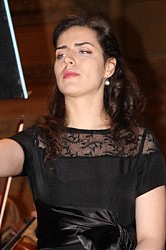
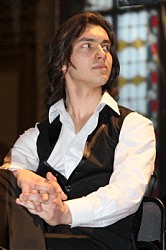
In short, like this: the old rabbi Aryeh Leib (Viktor Melnik, tenor) tells us how the handsome Benya (Igor Onishchenko, baritone) celebrated his sister’s wedding. Basya (Nina Kachur, soprano) saw the wedding and wanted the same for herself, having taken a liking to the grocer’s son. But… “they are looking for a grocer there,” poor Basya has no luck; and then her offended father Froim (Andrey Malinich, baritone) complains to Benya, having met him at Lyubka’s. Lyubka Kazak (Olga Krebs, mezzo-soprano). “God will help us, and we will punish all the grocers,” Benya’s monologue falls like a stone into water and spreads in ripples: with a wild dance, which suddenly fades, leaving behind sinister embers: “The police end where Benya begins.” And a lull before the storm hangs: “Even God makes mistakes,” Benya summarizes, and this is the starting point of the rebellion, reckless and merciless (“young man” in the scene “The Round-up” — Valery Zadorozhny).
The dance — a wild, melancholic daring, seeking an outlet — accompanies Benya’s theme. Basya and Lyubka are given amazing wordless vocalises, full of unquenchable longing, accompanied by a violin theme and single bell strikes, growing to alarm bell intensity. And here is the rebellion: “Good health to you, your excellency,” Benya enunciates, almost syllable by syllable, with a dance rhythm as the musical background, and now a fire has erupted, the police station is burning: cheerful violins weave their passages, like flames twisting in the wind…
The abruptly and suddenly interrupted musical themes of “The Odessa Legend”; their contrasting junctions; the recitatives of the vocal parts; Lyubka’s wordless, soul-wrenching cry and the lingering long pause — yes, this is the deep channel of Shostakovich’s innovative music, in which no one feels cramped, as long as there is something to say. The literary legend (“outline” of the libretto based on I. Babel’s “Odessa Stories” was compiled by the composer’s mother, musicologist Olga Nivel) is multiplied by musical tradition…
Tomlenova’s music can be “simply symphonic,” or it can be very theatrical in nature, as in this case; in general, Tomlenova is remarkably good at “painting a picture” with her scores, her music awakens the imagination. In this sense, I don’t even know what dances would have added to “The Odessa Legend”: their absence did not bother me, nor did it impoverish this “oratorio without a choir” in any way. But, if there were “dances,” they would rather be plastic constructions, pantomimes, not in unison, but in contrast to the musical theme, as a counterpoint: for example, a scene of pogrom or fire — to a klezmer melody.
So “The Odessa Legend” awaits its director…











