The last quarter of the 20th century saw the establishment and success of Vasyl Fashchenko’s literary studies school. The innovative research and concepts of the Odesa scholar found a worthy continuation in the work and pedagogical practice of his followers and students. Among Fashchenko’s postgraduate students, a trio of “musketeers” of the pen stood out – Hryhoriy Klochek, Volodymyr Panchenko, and Mykhailo Strelbytskyi. Their move to Kirovohrad and Vinnytsia after defending their candidate dissertations was initially perceived as a bad omen, even as a “betrayal” of their mentor. But the current status of each, their creative portfolios, suggest that central Ukraine is more favorable for national humanities.
As the twentieth year departs,
can you forgive yourself
the ability to sadly remain silent —
to yourself and the crowd, indeed,
the ability to silently scream
at every Golgotha hill,
that covers the land,
this one, that is yours — not yours, —
the land — Ukraine — paradise,
Ukraine — ruins — where am I?
The land, to which to serve
smiling Fashchenko taught —
your eternal Odesa Teacher,
your eternal guilty motive.
The land — everyone’s lure,
the land you did not know,
although you published with Derevyanko,
and he considered you someone.
Not someone, but… a spokesman for truth
(it’s also in the columns),
a stammerer, though,
absorbed in his own heart…
There is no doubt that Vasyl Vasyliovych Fashchenko chose his students not only for their abilities but also for key character traits — almost without error. It is no coincidence that Mykhailo Strelbytskyi, an excerpt from whose poem has just been quoted, calls his Teacher the founder of Ukrainian literary characterology. And if a person is capable of delving into artistic characters, they can also decipher living personalities. In the subtle bespectacled man from Khmelnytskyi region, Fashchenko saw a truth-seeker — a seeker — a defender — in poetry, literary criticism, and everyday life.
One of his books of poems and cycles of verses, Strelbytskyi titled “The Science of Gratitude,” and another, slightly later, more unpretentiously — “The School of Re-questioning.” So what kind of schools did the poet want to tell the reader about? Well-acquainted with all the trends of Ukrainian poetry, Strelbytskyi did not succumb to the temptations and fashions of postmodernists, who above all want to surprise, shock, and bewilder. His “shock therapy” is in traditional poetics, mentally “sharpened” for a conscientious interlocutor, resonating in broad ranges of good and evil. Literary tools are available to everyone. But some use them to artfully prove that nothing is sacred! However, Mykhailo would not have written a line “Love Oklahoma” under torture, as Oleksandr Irvanets did, parodying Sosyura’s “Love Ukraine.” That is why burlesque, spiced with kolomyika, sarcasm, and philippics, have taken root well in the books of the Khmelnytskyi-Vinnytsia-Odesa lover of wisdom.
Strelbytskyi also “respects” large formats: poems, cycles, multiplicity of genres. “The School of Re-questioning” has a section “Sonnet-Silhouettes. A Grand Gallery,” which contains two hundred works with dedications. In particular, “Odesa Exposition” includes grateful sonnets to the teachers of the Mechnikov University — Mykola Pavliuk, Hryhoriy Viazovskyi, Vasyl and Mariia Fashchenko, Stepan Bevzenko, Kost and Panas Danylka, writers Ivan Riadchenko, Stepan Kovhaniuk, Izmail Gordon, Borys Necherda, Taras Feduk, and personalities like Kira Muratova and Borys Derevianko — the list is not exhaustive. But even in these laudatory and praiseworthy verses, we find elements of epigrammatics. Character!
Strelbytskyi bravely attacks the fortresses of post-Soviet social psychology, which built its bastions on ancient foundations, say, outlined by Shakespeare. He cannot reconcile himself to seeing: “To the begging and humiliation of virtues, / To the carefree and noble cattle, / To the right that was silenced, / To false honor, to maiden beauty / Defiled, to betrayal in splendor, / To truth, which for the sake of the vile / Turns holy feelings into dirt” (part of the 66th sonnet by the English classic translated by D. Pavlychko). The modern reader, along with poets of the past and present, seeks answers to painful questions: why did the epidemic of collaborationism and greed strike precisely the Ukrainian elites — both parliamentary-political, law enforcement, military, and various bureaucratic ones? And who, from which stratum, can resist this unclean force? According to Strelbytskyi — Ivan the Walking Conscience (that’s the title of one of the poems). That collective hero, who in the last six months embodied the Heavenly Hundred of Maidan, who defends Ukrainian land with weapons in hand in 2014.
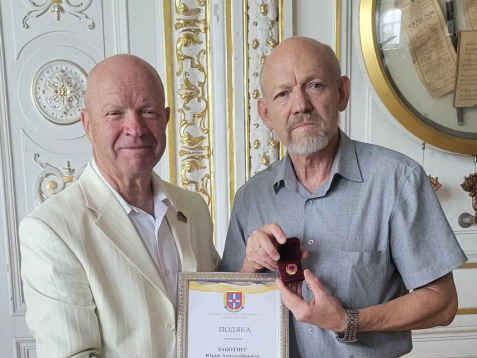
But the national ideal is affirmed not by ideal heroes, but by living people of high, consistently sacrificial calling. Such was the Podolian artist Fedir Zotykovych Konovaliuk (1890-1984), a student and even co-author of the great Ivan Izhakevych. He left a rich pictorial heritage, hundreds of illustrations for literary classics. He did not work labor days on the plantations and assembly lines of socialist realism, and therefore became a member of the Union of Artists only two years before retirement, and was able to hold his first personal exhibition at the age of 65. He idolized Shevchenko, and from the 1930s (of the last century) he painted self-portraits every year in the image of Kobzar’s Kateryna (!). The artist’s wife donated the preserved paintings to the Vinnytsia State Technical University, where a personal gallery was set up. It became a laboratory for the Department of Cultural Studies, where the poet and professor, this year’s jubilee celebrant Mykhailo Petrovych Strelbytskyi, has been working with inspiration for the third decade. Young democracies need not only a smart and socially just economy but also a unifying spirituality, humanities. At Vinnytsia Technical University, both physicists and poets are respected.
Mykhailo Strelbytskyi published a trilogy “Under the Sky of Konovaliuk” — which became not only a poetic monument to the artist but also a systematic and in-depth appreciation of the phenomenon of culture through the prism of time by contemporaries. And such a poem can be a series of professional authorial embodiments of reflections and readings:
The artist painted grasses,
but it turned out: dew.
The artist painted the sky —
heavens appeared.
He painted snow — the blizzard
sharply smelled for ages,
he painted a hut — longer
its destroyers went.
He painted the freedom of hills —
people did not blow away;
he painted all sorts of herbs —
people came from everywhere for herbs…
He painted a mill — and that mill
ground sorrow;
he painted a river — and that flow
began to play with the Sun!..
He painted fishing nets —
the catch hurried to them;
he painted everything in the world,
but it turned out: love…