

International Museum Day was marked by the opening of a large-scale solo exhibition of People’s Artist of Ukraine Albin Gavdzinsky in the halls of the Odessa Art Museum (5a Sofievskaya St.). The exhibition is dedicated to the 75th anniversary of the master’s creative activity.
Albin Stanislavovich, who turns 89 on July 4, was congratulated on opening the exhibition by the Director of the Art Museum, Natalia Polishchuk. His deputy, Elena Pavlova, conveyed “deep bows and congratulations” to the artist from the Mayor of Odessa, A. A. Kostusev. It is worth recalling that on February 28, the city council session began with the awarding of the People’s Artist of Ukraine Albin Gavdzinsky with the badge of honor of the Mayor of Odessa “Badge of Honor” – “for many years of fruitful creative work and significant personal contribution to the development of domestic fine art.”
The vernissage was very crowded; many famous Odessa artists came to pay tribute and admiration to their elder “brother in palette.” The landscape paintings and sketches on display were carefully examined and discussed by students from “Grekovka” and “Khudgraf.” “Look, literally everyone is here today! After all, he is a living legend,” noted Vera Savchenko, a researcher at the Art Museum, to me…
“The fact that there is so much light and air in these works, so much skill in appreciating every moment of life, is perhaps a result of the war he went through,” said Galina Boguslavskaya, head of the museum’s exhibition department. “Hardening and the ability to appreciate life are qualities of almost all people who have gone through war.”
A typical Soviet biography of a lucky village boy… turns out to be a humble worker. After all, what is striking when you are faced not with a couple of Gavdzinsky’s works in a group exhibition, but with a large-scale retrospective: the principled modesty of these canvases catches the eye. A humble palette. Quiet admiration. Intimacy of experiencing impressions of the external world. “His paintings cannot be called large-scale,” noted Elena Mikhailenko, director of the Nova Kakhovka Art Gallery named after A. Gavdzinsky: she noted this with significant “although” and “but” – yes, the paintings are small-format, quiet in essence, yet they captivate the eye!
The art gallery in Nova Kakhovka was established after the Odessa artist Gavdzinsky donated 237 of his canvases to this city – after his creative work during the construction of the Kakhovka Hydroelectric Power Plant, from 1951 to 1960. In 1961, he was awarded the title of Honorary Citizen of the city of Nova Kakhovka. In 2003, the Nova Kakhovka Art Gallery was named after Albin Gavdzinsky. “For 45 years now: this year we will celebrate our anniversary,” the gallery director proudly recounted.
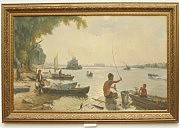
Well, what did she mean by the “lack of scale” of Gavdzinsky’s paintings, dedicated, it would seem, to such a loud and winning “production” theme of those years? It’s not hard to guess what was meant: apparently, Albin Gavdzinsky was not inclined to follow the conjuncture of socialist realism; he was a sincere and intimate artist by talent, and even conveyed “production” impressions in his paintings as personal experiences, unpretentious and thoughtful. He was most interested in nature – and man in nature. Even if man arrogantly called himself its “transformer.” “In those small works,” Elena Mikhailenko clarifies, “you can see the city, the river, a boat sailing. And Trubetskoy’s castle, which, unfortunately, has not survived – Albin Stanislavovich managed to capture this castle on his canvases!”
…In the 1940s-1950s, Albin Gavdzinsky studied at the Odessa Art School, which he graduated with honors, under the teacher N. A. Pavlyuk. Why… so long? The war! In 1941, a first-year student, a future painter, was mobilized and, after graduating from the Rostov Pilot School and then the Chernihiv Military Aviation School, worked in aviation as an instructor – training fighter pilots before they were sent to the front. He resumed his studies as an artist in 1946.
And his talent manifested early: in 1938, the boy became a laureate of the “Young Artist” magazine competition. And in 1951, he debuted at an all-Union exhibition with the painting “The Beginning of a Great Construction.” Today’s youth cannot be impressed by participation in an “all-Union” exhibition, when today everything is “international.” If only they knew how difficult it was for a 28-year-old artist to break into an “all-Union” exhibition (to Moscow, where works from the exhibition were invariably bought by the state!) – through the impenetrable cordons of art councils!..
Today, Albin Gavdzinsky’s works are housed in museums in Kyiv, Moscow, St. Petersburg, Odessa, Mykolaiv, Kherson, Lviv, Sevastopol, and Alupka.
THE EXHIBITION features exclusively landscapes. Each visitor will find something close to them: Gavdzinsky is multifaceted. What is constant in his work is adherence to the principles of the South Russian school (art critics note his continuity from K. Kostandi’s students) – today this “school” is applied to Odessa painters “at full tilt,” and this is not entirely correct – one should look at Gavdzinsky’s canvases to be convinced. He has a consistent method, adjusted for time: the palette has become significantly lighter, with some French influences, it seems.
A resonant “Winter Landscape” with its deep, complexly mixed blue of shadows, contrasting with the soft pinkish glow of snow in the pre-evening rays… A purely Odessa joy, a “tasty” essence of being, in a painting where a cut melon on a white tablecloth is displayed against the backdrop of a blinding sea. Boisterous energy is evident in the impasto, thick, painterly layer of “Alley in the Botanical Garden” and “Moonlit Night” (it is characteristic that both sketches are tiny: the artist restrains his temperament with format). Constructive rigor is in the landscape “Towards Evening,” where the temple building is meticulously, portrait-like, rendered, and in the foreground are charming, intimate details of the backyard: scratching chickens, a haystack, laundry on a line.
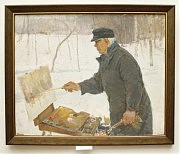
In general, Gavdzinsky, despite the sunniness of his palette, is not loud, and sometimes restrained to asceticism. Such is the pearly color of “Misty Day,” with the silhouette of a temple through the crowns, such is the “Monument to T. G. Shevchenko” – a small, but panoramic urban landscape; such is the “parchment-like” in color “Autumn on the Dniester.”
There are two significant portraits at the exhibition. This is a portrait of the artist V. M. Sinitsky (a follower of K. Kostandi) from 1986, from the collection of the Odessa Art Museum: psychological, finely detailed. It depicts a man with an introspective, intelligent, and sad gaze, with heavy working hands, against the backdrop of a Crimean landscape, his own – enclosed in a gilded frame. The other portrait features a red-haired, green-eyed mermaid, luxurious and radiating health: truly, the ideal Odessan woman! This is the artist’s daughter, Elena, captured when she was 18 years old. The painting is impressionistic, light-filled, with complex chiaroscuro, all based on colored reflections: there is something to learn if you are a student of “Grekovka.”
And one more “portrait” at the head of the exhibition, on the end wall: our Opera House. How could it be without it – “our brand”! A living being, one might say, for an Odessan…











