

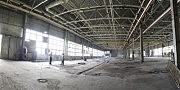
The first impression is that we are on a movie set, with scenery for the filming of “Stalker” erected. Or we are watching a documentary about the horrors of war, when the enemy, retreating, destroyed everything around out of impotent rage. Everywhere is the triumph of devastation: half-collapsed buildings with empty eye sockets, piles of broken construction debris, scraps of wires hanging from the walls.
Inside the surviving industrial premises, there are also traces of a vandal feast. Where the machines stood, pits gape. They were ripped out, as they say, by the roots. Underfoot, where there used to be cast-iron tiles, there is debris and dust. Like fingers gnarled with gout, single iron structures hang from the ceiling, which resisted to the last the urge to tear them from their fastenings.
Outside, there is rubble of broken glass and brick, waist-high weeds. And silence.
This is what the Odessa Auto Assembly Plant looks like today, without which it was impossible to imagine the industrial potential of our city and Ukraine as a whole until recently. And in Soviet times, the enterprise was held in high regard.
The plant was built at the end of the war, in February 1945, for the assembly of trucks that were delivered from the USA in disassembled form. Then the enterprise was entrusted with the production of components for the military-industrial complex. OdAZ also produced civilian products: dump trucks, trolleybuses, general-purpose semi-trailers, refrigerated semi-trailers, and trailers. In the 1980s, the plant became the leading enterprise in the USSR Ministry of Automotive Industry system for the development and production of this automotive equipment.
Thirty years ago, over three thousand people worked here. The plant successfully “recovered” from perestroika conversion – it began producing refrigerators and transitioned to the rails of a market economy, brought by Ukraine’s independence, without significant production shocks. A vocational school operated on the enterprise’s territory, where over a hundred people annually trained for blue-collar professions in five groups. Yesterday’s schoolchildren became electricians, fitters, turners, and mechanics.
In 1993-1994, the enterprise was privatized, transforming into the closed joint-stock company “Odessa Auto Assembly Plant” (CJSC “OdAZ”). Its owner became the labor collective. By decision of the Executive Committee of the Odessa City Council No. 471 dated March 27, 1998, CJSC “OdAZ” received the right to use a land plot with a total area of 22.35 hectares at Ataman Chepigi Street, 29 (Peresyp district) for the operation and maintenance of the auto assembly enterprise and sports complex. The plant itself occupies 18.7 hectares.
And in 2001, disaster struck. The Economic Court of the Odessa region unlawfully initiated bankruptcy proceedings against CJSC “OdAZ” and then, during the rehabilitation procedure, transferred the entire property complex, valued at 55 million hryvnias, to an investor – the firm “Auto Assembly Production” with a charter capital of 14 thousand hryvnias – for free. The scheme, in which a settlement agreement was concluded with the investor within the framework of a bankruptcy case, with the transfer of all property to him, was a standard raiding scheme at the time. “Tsentrolit” and “OdessaCement” also fell under its wheels at practically the same time.
The struggle to reclaim the auto assembly plant lasted almost ten years. All this time, the “resistance movement” against raiding, led by Eduard Gorin, who has headed the enterprise since 1981, did not lose hope that justice would be restored.
In November 2007, under the chairmanship of the then First Vice Prime Minister Mykola Azarov, a meeting of the interdepartmental commission for combating raiding was held. Having considered the situation around the Odessa Auto Assembly Plant, it concluded that “…signs of unlawful (“raider”) seizure of enterprise property, carried out with the help of opening rehabilitation proceedings, are evident.” In this regard, N. Azarov gave instructions to the State Property Fund, the Ministry of Economy, and the Prosecutor General’s Office to investigate the incident and take appropriate measures.
It was the meeting of the interdepartmental commission that became a turning point in the history of returning the enterprise to its rightful owners. From that moment on, the judicial flywheel began to spin in the opposite direction. If the state had also compensated the enterprise for damages from the raiding attack in the amount of 37 million UAH, then justice would have been restored.
As E. Gorin recounts, when the gates of their native enterprise were reopened to the labor collective, he was very concerned about the health of his employees. Workers, entering the workshops where they had worked for decades, did not hide their tears, seeing the damage inflicted on the enterprise by the so-called “investor.”
It is noteworthy that the state acknowledged its guilt in aiding the raiders. In December 2009, the Supreme Economic Court of Ukraine, by its ruling, overturned all decisions of the Economic Court of the Odessa region and terminated the bankruptcy proceedings. A year later – in November 2010 – the property complex was returned to CJSC “OdAZ” through court order.
In general, since November of the year before last, the auto assembly plant has entered a phase of revival. The number one task is to remove household and construction debris and restore production sites. In April of this year, the reconstruction of the plant began, which will allow for the assembly of trailers and semi-trailers. Thanks to this, 250-300 new jobs will be created.
According to the Chairman of the Board of CJSC “OdAZ” E. Gorin, the period of raider management has another negative consequence – the market has been almost completely lost. Partner counterparties and consumers have begun to forget about the Odessa Auto Assembly Plant.
Therefore, task number two is to restore previous ties. And there are already results in this direction. Just a month ago, CJSC “OdAZ” signed a memorandum of intent with the flagship of the Belarusian economy, the Minsk Automobile Plant, according to which the Odessa enterprise will assemble certain models of MAZ vehicles from supplied machine kits.
This cooperation is beneficial for the Belarusians, as they gain an assembly site in a country where their products are in stable demand, and transportation costs, which existed when finished vehicles were transported from one country to another, are eliminated. Therefore, MAZ is ready – within the framework of the memorandum of intent – to provide the Odessa residents with all production know-how, as well as to provide gratuitous engineering assistance in organizing assembly production.
Cooperation with the Belarusian auto giant is also beneficial for the Odessa Auto Assembly Plant. Moreover, it fits perfectly into the developing automotive industry development program, which was mentioned by the President of Ukraine Viktor Yanukovych during the solemn ceremony of launching serial production of ZAZ VIDA cars at PJSC “Zaporizhzhia Automobile Plant.” The head of state, in particular, promised effective state support to enterprises that have embarked on the path of production modernization.
One could put a period to the “newest” history of CJSC “OdAZ” here. But in a barrel of honey, as you know, there is not always a spoon of tar. For the Odessa Auto Assembly Plant, it has taken the form of land tax.
The city authorities have approached this issue with extreme detachment, despite the fact that the enterprise is undergoing major reconstruction. The plant occupies 18.7 hectares – pay the land tax in full. It amounts to 130 thousand hryvnias per month. And where can they get it? Today, the enterprise survives by renting out individual office spaces and production sites. It earns 160-170 thousand hryvnias monthly. It pays salaries, all necessary taxes, and utility bills. But the land tax does not fit into this financial scheme at all. If it is paid now, the plant can be closed immediately – there will be no money left for anything else.
Therefore, the Chairman of the Board of CJSC “OdAZ” is writing petitions to the Mayor of Odessa, Aleksey Kostiusev, and the Chairman of the Standing Commission of the Odessa City Council for Planning, Budget, and Finance, Yuriy Presnov, requesting a deferral of land tax payments, its restructuring, or the provision of benefits. After all, it is not the employees of the enterprise who are to blame for having to restore production activities from scratch.
But there is no response from the mayor. And the commission, without ever inviting E. Gorin to its meeting, responds, without going into explanations, in a very monotonous way: “consider it inexpedient.”
A primary organization of the Party of Regions has been established at the plant. The enterprise’s employees tried to raise the issue of providing land tax benefits through party channels. But neither the faction of the Party of Regions in the city council nor the party organization of the Suvorovsky district expressed their point of view.
Perhaps this is because all the aforementioned leaders have never – at least since November 2010 – visited the auto assembly plant? However, such an excursion through the workshops and production sites that survived the raider attack would allow the mayor, city council deputies, the chairman of the standing commission for planning, budget, and finance, and the head of the district administration to clearly and knowledgeably answer the question: does Odessa need an auto assembly plant? If it does – then help its revival.











