

An exhibition of works by the renowned Czech artist Mikhail Shchigol, who is deeply connected to our city – his parents are from here, and he spent his childhood here – has opened at the Alexander Korobchinsky Art Center (Pushkinskaya, 32).
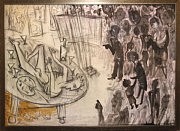
The exhibition space is filled with tension; there are simply no easy-to-perceive canvases here, and certainly no scent of socialist realism, which the artist was required to adhere to by the times. It is known that Shchigol’s first solo exhibition took place in 1969 in Kyiv, but it was closed the very next day after a visit from an official from the Ministry of Culture. The second exhibition, held in 1974, lasted for 3 days. It would have been no happiness, but misfortune helped: his wife tragically passed away, leaving Mikhail with a sick child. Emigrating to Czechoslovakia in 1990, he was not seeking a happy life for himself, but doctors for his son.
It was in emigration that he achieved success. Perhaps the genetic inclination of Czechs towards the tragic, mysterious, and dark played a role. The torn souls and restless bodies in these paintings evoke a state of tension in the viewer. One might think, who would hang such a thing in their home? But no, there are such people. Today, Mikhail Shchigol has over 100 solo exhibitions in the Czech Republic, Austria, Germany, the USA, Italy, Belgium, the Slovak Republic, and Ukraine. And so, the artist came to Odesa, the city of his childhood, accompanied by Czech collectors passionate about his work. The exhibition features about 100 canvases by the artist, painted between 1990 and 2011.
— When a patron appears, the artist falls in love with them, — admitted Mikhail Shchigol. — And even starts giving them works. In Czechia, there have been many examples where influential figures patronized painters and sculptors. For instance, Count Špork was a patron of the great Baroque sculptor Matěj Braun. And although it is believed that an artist creates for themselves and their interest lies somewhere higher, I always seek contact and approval from my viewers. For me, the main charm of painting lies in its mystery. Painting that is predetermined, exists before your eyes, and only needs to be drawn, does not attract me. Approaching a blank canvas, I sometimes feel completely helpless, with no certainty of success. It’s something like an adventure, discovering a new continent. I can’t say I create for all humanity – when I paint, I think about the people close to me.
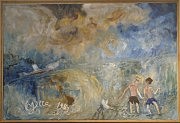
The most serene and calm works of the master are connected precisely with Odesa, for example, “A Walk with an Elephant” – leaving the beach behind, two young brothers walk hand in hand, and behind them, a toy elephant on a board with wheels is pulled by a string.
— The theme of freedom came to him from childhood, — comments art critic Olga Tarasenko. — He has preserved a piece of his childhood, the memory of how happy walks hand in hand with his brother were. When we are children, we have no protective shell, no cocoon; we are easily permeable to both good and bad. A good artist is always permeable, always open and defenseless, and if they are clad in armor, they are no longer an artist. Mikhail’s open heart, emotional and spiritual experience allow him to create art that does not suppress; it brings catharsis. Many are ready to pour out their suffering, but not to lead us to the heights of the spirit. And a person who has managed to structure the trials sent from above is a hero to me.
As a rule, Mikhail Shchigol’s paintings are united into thematic cycles: “The Great Cherry Robbery” (1990-1995), “Nights in Železnice” (1990-2006), “Tristan and Isolde” (1993), “The Studio” (1995-2011), “Uncle Ted’s Album” (1997), “Biblical Motifs” (1988-2011), “The Passion of the Lord” (2010), and others. In total, the artist has created about 500 works in oil painting technique. His painted myths are full of creative exaggeration with elements of grotesque and self-irony. They evoke a series of literary associations. Critics have noted a closeness to Kafka with his defenseless insect-hero in the cycle “Feast at the Vernissage,” where the naked figure of the artist is sprawled on a table with remnants of a feast, and this table stands in an exhibition hall where viewers are entering. They have also “accused” him of closeness to Proust (“A Walk with an Elephant,” “Uncle Ted’s Album”), and to Kharms (“Dance with the Muse”). It turns out that one can be born in Odesa and organically fit into European culture. However, family legend speaks of Mikhail Shchigol’s Czech roots. Thus, he is aided by the land of his ancestors.
In emigration, Mikhail thoroughly studied the Czech language and history, and even restored historical justice by creating a cycle of paintings dedicated to Albrecht Václav Eusebius von Wallenstein, a politician and military leader whose attitude in Czechia was as ambiguous as that towards Ivan Mazepa in Ukraine. And now, after a series of exhibitions, Wallenstein has even been dedicated several pages in textbooks, which was not the case before, the artist claims. Several portraits of this hereditary aristocrat, who somewhat resembles Don Quixote, have also been brought to Odesa.
— I want to congratulate Misha on preserving his attachment to his homeland, his kind remembrance, — adds Kyiv art critic Olga Petrova, a long-time friend of the artist. — Childhood and remembrance sustain him in life. Critics love to compare him to Marc Chagall, but the only thing they have in common, in my opinion, is the aspiration for flight. He is constantly balancing, sometimes plunging us into the abyss of sorrow, sometimes lifting us to the sky. I am glad that after many years he found me in Kyiv and arranged my trip to Odesa with an exhibition of his, as I call them, “richest elusiveness.”
It remains to add that the exhibition of the Czech Odesan will last until November 14.











