

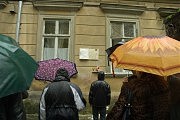
On October 26, a memorial plaque was solemnly unveiled in Odessa in honor of the classic of the Odessa school of painting, chairman of the “Society of South Russian Artists” Kyriak Kostandi (1852 — 1921). The memorial plaque made of colored marble, created by the famous Odessa sculptor Alexander Kniazik, is installed on house No. 46 on Pastera Street. The artist’s family lived at this address from 1910 to 1916.
The initiative to perpetuate the memory of the artist, a significant figure in the history of Odessa, was put forward by the World Club of Odessites, and the role of a patron was taken by the well-known entrepreneur and collector Evgeny Demenok. October was a significant month for the master himself, as Kostandi was born on October 3, 1852, and died on October 31, 1921.
Speaking at the solemn ceremony of unveiling the memorial plaque, poet Stanislav Aidinyan recalled that Kostandi was a great connoisseur of historical objects and antiquities; and the director of the Odessa branch of the Greek Cultural Foundation, Safronys Paradissopoulos, emphasized: Odessa has always been hospitable to representatives of other nationalities, and Greeks are by no means an exception.
Kyriak Kostandi is a famous painter, a representative of Impressionism. He was born in the village of Dofinovka near Odessa into the family of a Greek emigrant K.K. Vasilketi, whose modified patronymic (Konstantinidi) apparently became the basis for the surname Kostandi. At the age of nine, he was left without a father, worked in a grocery store and a wine cellar in Odessa. From 1868, he served as a retoucher in a photo studio. He studied at the Drawing School of the Odessa Society of Fine Arts (1870 — 1874), and then at the St. Petersburg Academy of Arts (1874 — 1882). In 1885, Kostandi returned to Odessa, where he lived his entire life. In 1887, he visited several Western European countries, being deeply influenced by the French Impressionists. He was a member of the “Society of Traveling Art Exhibitions,” as well as one of the founding members of the “Society of South Russian Artists,” and held the post of chairman of this association (1892 — 1919). For many years (from 1885), he taught at the Odessa Art School. After the revolution, he worked as an expert for the local commission for the protection of historical monuments, and participated in the reorganization of the school and the Museum of Fine Arts.
Kostandi died in Odessa on October 31, 1921. In 1922, students and friends of the artist (I.I. Brodsky, P.G. Volokidin, M.B. Grekov, A.A. Shovkunenko, and others) founded the Kostandi Society. The society united artists of traditionalist and moderately modernist orientation and existed until 1930. The paintings of Kyriak Kostandi are housed in the Tretyakov Gallery in Moscow, the Museum of Ukrainian Art in Kyiv, the Odessa Art Museum, and many other collections.
In Odessa, one of the streets and a children’s art school are named after Kostandi. This year, the Kyriak Kostandi Odessa Art School turned exactly 65 years old; the anniversary was on August 29. The director of the school, Valery Tokarev, was also present at the unveiling ceremony of the memorial plaque.
— Our school was organized by a decree of the Council of People’s Commissars signed by Nikita Khrushchev himself, — said Valery Filippovich. — All other Odessa schools of aesthetic education were established by order of local authorities, so ours is unique. Masters such as Leon Mezberg, Stanislav Bozhiy, Alexander Shelyuto, Grigory Palatnikov, Lucien Dulfan, Valentin Khrushch, Alexander Shopin studied here… Over all these years, more than 2600 graduates have passed through our walls, and now 440 children are studying. On the occasion of the anniversary, we managed to publish a book about the teachers, “To You — a Constellation of School Names.” And in early October, as part of the anniversary celebrations, we prepared a theatrical performance based on our own script. We have proudly borne the name of the founder of the South Russian school of painting, Kyriak Kostandi, since 1991 — and we do so with dignity: at international competitions, dozens of our students win Grand Prix and gold medals.











