

Today, the Museum of Modern Art of Odessa opens an exhibition, or rather, a large-scale project by Sergey Lykov, a representative of the Odessa “new wave” of conceptualism – “Selected Works”. In accordance with the concept of the staff, it will be retrospective in nature. The exhibition is located in three halls of the museum and provides an opportunity to get acquainted with the main periods of the artist’s work.
Sergey Lykov is an aesthete artist capable of reflection. His individual works and cycles of paintings are quite well-known – “Baroque Concert”, “Dream Catchers”, “Caravaggio’s Distrust”, and others. Art for this artist is primarily a way of cognition, accumulating the historical experience of humanity. By comprehending it on an individual level, he generalizes it, as it were, “draws a line”. After all, the circle of ideas, images, their forms of expression, the permissible range of human feelings and emotions, as well as methods of interpretation, have found their perfect expression in world art. Only accents and combinations change. A painting has become a museum piece, an artifact, acquiring new resonance in the context of time. Postmodernists believe that everything has already been created, expressed, and said before us, as, incidentally, are similar judgments.
Sergey Lykov is diverse in his work. In one of his earliest and most intimate series – “Wild Shadows of Love” (mid-1990s), there is a certain understatement, concealment, and ephemerality. In a philosophical sense, this is pure Neoplatonism with its primacy of idea, where the material exists as something temporary. It seems that the present in our consciousness becomes the past, fleeting, like a dream and a memory. Here, as in other cycles of metaphorical paintings (“Dream Catchers”, 2007-2008), the author uses a meditative approach. He has a lot from the East. With his work, Lykov tries to implement a certain program, to create a symbiosis of different civilizations, different mentalities – European and Eastern. In this completely sincere aspiration, he is irrational. There is a large share of idealism, even romanticism here. The explanation should also be sought in the artist’s fascination with the teachings of the Mexican shaman of indigenous origin, Juan Matus.
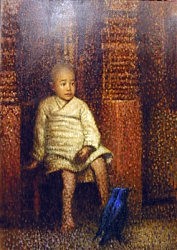
In this sense, the aforementioned reference to Baroque or Gothic is also a kind of romanticism of an aesthete, not without a certain pretentiousness (and perhaps, as some believe, snobbery). I am not sure if it is conscious, but Lykov’s fascination with Orientalism is in some sense destructive (“Caravaggio’s Distrust”, 2007), as it leaves less room for belief in the myth nurtured by Europeans over two millennia.
It must be admitted that for this artist, unlike modernist artists, form is not an end in itself. This does not mean that he neglects the formal side of the matter; on the contrary, true to the teachings of his teachers – Valery Gegamyan and Zinaida Borysyuk, Lykov strives for technical perfection. In this regard, he is quite conservative, pursuing formal completeness. His priorities seem to have been determined during his studies at the art and graphics department of the Odessa Pedagogical Institute (graduated in 1985). However, the artist skillfully used the strengths of his talent, creating his own, flexible, not devoid of eclecticism, visual system. Depending on the subject matter, it undergoes changes.
In the series “World History in Pictures” (2001), with its hierarchy and “frieze” approach, rhythms are important, developing both along the plane and in depth. In this cycle, Sergey Lykov showed himself to be a consistent postmodernist, skillfully using pop art techniques and the style of ancient art, in particular, Babylon and Egypt.
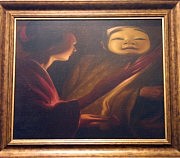
The artistic language of Sergey Lykov is characterized by the use of various effects suggested by our technogenic era, for example, from the arsenal of computer graphics. There is an impression of blurriness, soft color transitions within the spectrum, the effect of turbulence, sphericity, “inward pull”, and others (“Caravaggio’s Distrust”, “Dream Catchers”, 2007). Despite the conceptual conditioning, in some cases they are not entirely convincing and, with their deliberate nature, border on salon art. Although Lykov is too intellectual for “salon art”. However, one should not be afraid of this definition, as we know excellent examples of such art, for example, the works of Henryk Siemiradzki or Paul Leroy (whose canvases adorn the halls of the Odessa Museum of Western and Eastern Art). As an aesthete artist, Sergey Lykov treats classical heritage with reverence – it is a source of additional creative impulses. Lykov’s other means of expression are more traditional: counter-illumination, nocturnal contrasting lighting – techniques that, besides Caravaggio, were used by Georges de La Tour, G. Honthorst, and other masters of nocturnal effects. One of the most illustrative, in terms of the richness of formal approaches, is the aforementioned cycle “Dream Catchers”: from the use of academic to symbolic-meditative and impulsive-expressive approaches.
Postmodernists (like masters of Japanese painting) like to accompany their paintings with texts. Lykov is no exception. He is well-versed theoretically, fluent in literary language, and capable of unobtrusively providing the viewer with perceptual guidelines. In conclusion, I will quote the artist’s words, which allow him to be better understood: “If the works awaken certain feelings and thoughts in the viewer, the creative act continues. It is not so important how different the initial author’s message and the viewer’s further interpretation are – it seems to me personally that the creative continuation of meditation on the proposed theme is more important.” Sergey Lykov seems to have found his audience; he has his own stable circle of admirers among art critics, colleagues, and staff of actively operating museums, which is further confirmed by the artist’s new exhibition.











